2025-26 MBA Admissions: Trends Defining the Class of 2028
October 1, 2025
Read MoreJuly 19, 2025
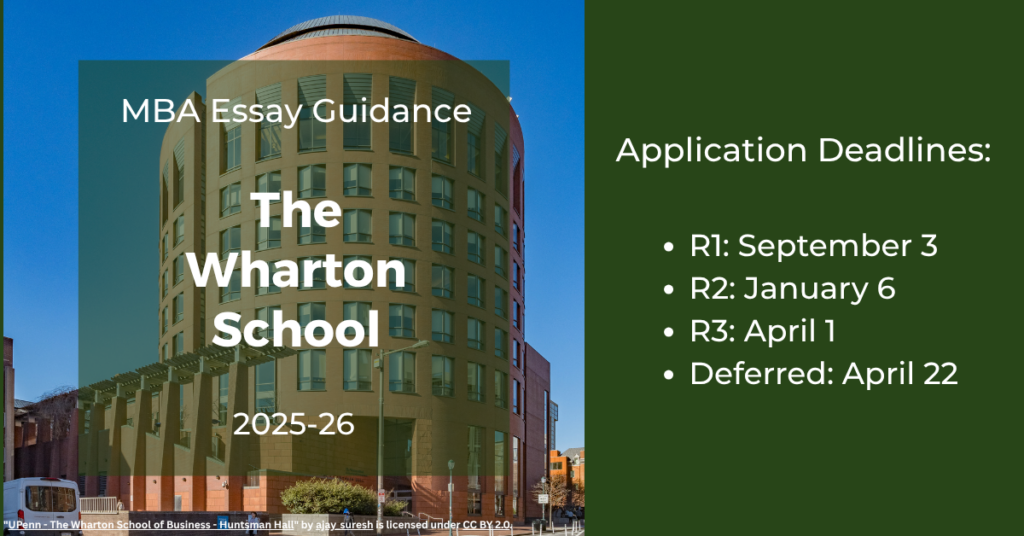
The Wharton School’s MBA program is a full-time, two-year experience at the University of Pennsylvania, renowned for its rigorous, flexible curriculum and robust global offerings. Students pursue a general business education core and can tailor their learning through 21 different majors and nearly 200 electives to align with their unique goals and backgrounds. Collaboration, analytical thinking, and practical leadership are central to the learning approach, fostered by tight-knit cohorts, faculty who lead both in academia and industry, and a diverse, engaged student community. The program emphasizes professional development, with career management services and global immersion opportunities enhancing students’ leadership and business acumen.
Wharton seeks MBA applicants who demonstrate strong academic achievement, with recent classes averaging a 3.6 undergraduate GPA and a (legacy) GMAT score around 728 or GRE scores averaging 324. However, more than statistics, successful candidates show evidence of leadership potential, professional maturity, and the ability to contribute to Wharton’s collaborative environment. Most incoming students have five years of experience, though they range widely in background, including consulting, finance, technology, nonprofit, and government. The admissions committee values applicants who can articulate clear goals, display growth and progression in their careers (regardless of years worked), and bring diverse perspectives and skills to the community.
With a clear understanding of what Wharton values in its applicants and how the MBA program is structured, it’s time to focus on one of the most crucial parts of your application – the essays. These essays are your opportunity to bring your story to life beyond the numbers and credentials.
What is your immediate post-MBA professional goal? (50 words)
Follow Wharton’s tips here. If you have space to state a Plan B, do so. The Plan A and (if stated) Plan B should be equivalent paths to the goal stated in Short Answer 2. Do your due diligence here so that your immediate post-MBA goals align with your three-to-five-year goals.
What are your career goals for the first three to five years after completing your MBA, and how will those build towards your long-term professional goals? (150 words)
Be sure to ensure that you have drilled down deeply enough on the long-term goals here so they don’t sound generic. Don’t just state ‘health tech’ or ‘private equity’ goals; show some specific niches within those spaces. Be ambitious; state long-term goals that aren’t merely pragmatic but, if relevant, have some legacy or world-impacting dimension. Feel free to state a professional Plan B and even ‘secondary’ nonprofessional career goals (e.g., nonprofit or politics), if you have them.
Taking into consideration your background – personal, professional, and/or academic – how do you plan to add meaningful value to the Wharton community? (350 words)
In addition to reducing your available word count by 50 words, Wharton has broadened its focus in this essay. Where last year’s prompt asked for “contributions,” this year you’re only asked to discuss the “value” you will add to the class. In practical terms, this means that instead of stating the specific and concrete impacts you will have on campus, you now only need to discuss what you bring to your class, that is, the differentiators ‘personal, professional, and/or academic’ that together will constitute your unique presence at Wharton. So the focus of this essay has shifted from what you will do at Wharton to what makes your candidacy distinctive relative to others. Start with the 3-4 aspects of your profile that really differentiate you. This could be a combination of your industry or function professionally, your personal backstory (unusual life experiences or diversity aspects), and any community involvements or hobbies. Note that you don’t necessarily need to tick every box Wharton gives you – ‘personal, professional, and/or academic’. If your most significant differentiators are your career, you can lean the essay toward your professional distinctiveness. Most applicants, however, should strive to anchor their 3-4 differentiators from across their lives. In Admitify’s opinion, the applicant who focuses too much space on the academic is hurting themselves. Show Wharton that you are a well-rounded person.
As Wharton’s guidance makes clear, the change in emphasis in this year’s prompt does not excuse you from taking the additional step of connecting your differentiators to specific ways you plan to get involved at Wharton. Wharton does want to hear “how you’ll get involved” at Wharton; they just don’t want it to be the main focus of the essay. So focus about 75 words, but no more than say 100, to describing the specific Wharton community activities (e.g., clubs) where you can share your 3-4 differentiators. For this second piece of the essay I recommend drilling down and finding out as much as you can about the relevant activity. It’s not enough to say ‘I will be an active member of the Hang-gliding Club.’ Google the club/activity, reach out to club officers, look for ways in which you could add value or take the club in a new direction (such as starting a conference, adding a new geography, etc.) Take a hint from Wharton’s Team-Based Discussion prompt where they regularly allow participants to give them ideas that will help them improve Wharton. Do the same here: add value. But the main focus of this prompt is now on your personal “experiences, values, or perspectives,” not your Wharton contribution.
Please use this space to share any additional information about yourself that cannot be found elsewhere in your application and that you would like to share with the Admissions Committee. This space can also be used to address any extenuating circumstances (e.g., unexplained gaps in work experience, choice of recommenders, inconsistent or questionable academic performance, areas of weakness, etc.) that you would like the Admissions Committee to consider. (500 words)
Wharton is allowing applicants to share information that is not necessarily an exculpatory explanation (damage control). Given that Wharton offers only two required essays and that they are short, most applicants who don’t have extenuating circumstances to explain should take advantage of this essay to share something important or something that further ‘rounds out’ their profile. Applicants who do have extenuating circumstances to explain can use any remaining space for this ‘rounding-out’ material, which should be positioned above any extenuating circumstance explanations. This rounding-out content doesn’t need to be an accomplishment. If it is, it should not repeat accomplishments already shared in the 2 main essays or in the recommendation letters and should clearly be a high-impact accomplishment. This rounding-out content can also be personal as long as it shares something not found elsewhere in the application that truly shows another significant side of you. The essay’s content can be broken into separate paragraphs with a header/title word that tells the admissions reader what’s coming. Applicants who use this essay to ‘share something new’ (not extenuating) should add a sentence at the beginning that directly states why they think this additional information will be helpful to the committee.
Sign up for a Free Profile Review and take the next step in your MBA journey!