2025-26 MBA Admissions: Trends Defining the Class of 2028
October 1, 2025
Read MoreJuly 7, 2025
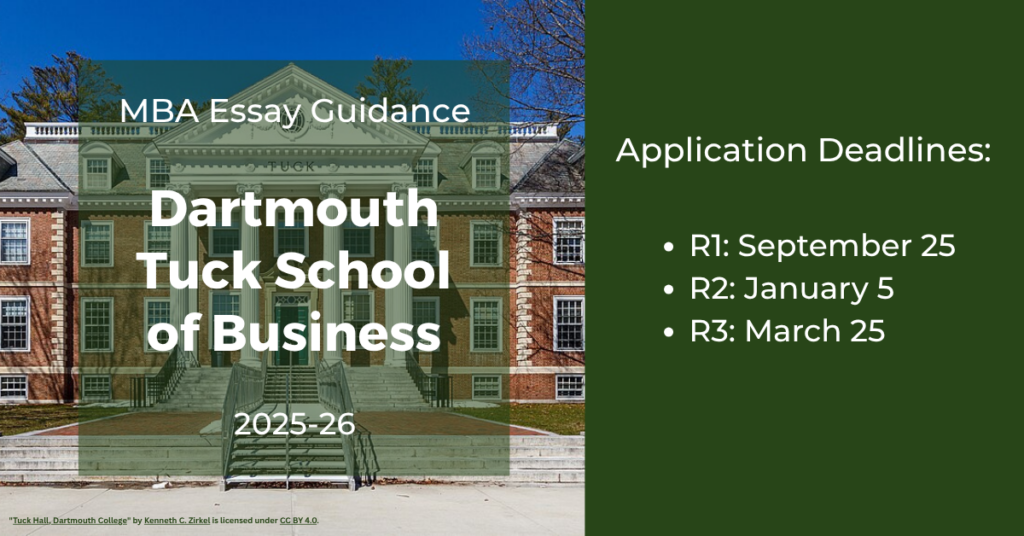
The Tuck School of Business at Dartmouth offers a renowned full-time MBA program, recognized for its rigorous general management curriculum, immersive learning environment, and close-knit residential community. Over 22 months, students engage in a blend of core courses, electives, team-based projects, and experiential global learning opportunities designed to develop analytical, leadership, and interpersonal skills. Tuck’s approach emphasizes self-reflection and peer feedback, ensuring graduates are prepared to lead with confidence and collaborate effectively. The school’s small class size, supportive alumni network, and personalized career services foster strong bonds and lifelong connections, making Tuck an ideal setting for those seeking a transformative business education experience..
As you consider applying to Tuck, a key part of the process is crafting thoughtful responses to the 2025–26 MBA essay questions. These essays are designed to assess your motivations, values, and fit with Tuck’s collaborative culture. In the next section, we’ll break down each essay prompt and provide targeted guidance to help you present your strongest application.
Why are you pursuing an MBA and why now? How will the distinct Tuck MBA contribute to achieving your goals and aspirations? What particular aspects of Tuck will be instrumental in your growth? 2000-character limit)
Despite a few changes from the 2024-25 prompt, this is a standard Goals + Why Us? essay. The Why Tuck piece is far more important than the Why an MBA piece, however, so devote two-thirds of the word count to a meaty, savvy, due-diligenced discussion of the specific Tuck resources (classes, faculty, out-of-classroom experiences, culture, etc.) by name (as in state the actual specific name of the resources; don’t generalize about them) that connect with your post-MBA goals. If you also want to mention Tuck resources that have very little to do with your goals but attract you, go for it, but at least 75% of the Why Tuck material should be directly relevant to your goals. Why? Because you want to convince Tuck that its resources (rather than its rankings or brand) are why you seek admission. Given that Tuck only gives you 2000 characters, we recommend cutting to the chase and stating your long- and short-term post-MBA career plan (perhaps mentioning your Plan B) directly at the start of the essay. Be as specific as possible, for example, name relevant job titles or organizations by name, and if space permits, state how the short-term goal helps get you to the long-term goal. You can address the ‘Why an MBA’ question in 1-2 sentences between the goals statement and the Why Tuck section: which skills do you lack that your goals require and that a Tuck MBA can give you?
Tell us who you are. How have your values and experiences shaped your identity and character? How will your unique background contribute to Tuck and/or enhance the experience of your classmates? (2000-character limit)
Treat this as you would Harvard Business School’s old ‘what more would you like us to know?’ or Stanford’s ‘What matters most?’ prompts: this is where you drill down and spill your soul, your deepest drivers, the experience or cause or passion that most defines you – even if it has absolutely nothing to do with your current career (though hopefully it will connect with why you seek an MBA). 2000 characters (about 330-400 words) is not very much so you will have to shoot your shot with maximum economy, vividness, and self-exposure. Don’t waste word count on general ‘thematic’ statements; cut to the chase. If who you are is defined by an experience or challenge you have lived, then start describing that experience. If who you are is defined by a passion, then begin describing what you really love about that passion (hobby) and how good you are at it. If who you are is defined by some mission or goal then start telling us where in your life that mission comes from and what you’ve been doing to realize it.
This is the essay where you let your personality shine through. Note that Tuck’s use of “identity” signals that they are very interested in any demographic categories (ethnicity, etc.) that you identify with. Note also that their use of the words “values” and “character” signal that they are interested in learning about your personal principles/ethics – the standards that guide your behavior as you choose your actions in the world. Finally, note that this year’s tweaks to this prompt ask to you focus more on what you will contribute to Tuck – so devote a sentence or two to connecting your personal differentiators to the specific Tuck activities where you will channel them (but don’t just name those activities, suggest specific ways in which you may improve them).
If an essay about ‘who you are’ comes across as dull or phoned in, then you will have a big problem getting the admissions reader interested in you. End the essay with a sentence connecting the ‘who you are’ to specific Tuck activities where ‘who you are’ can be expressed, suggesting specific contributions you might make (e.g., how you might change/improve student clubs that align with your identity).
Describe a time when you meaningfully invested in someone else’s success without immediate benefit to yourself. What motivated you, and what was the impact? (2000-character limit)
This prompt has been substantially changed from last year to encourage you to focus on an act of selflessness that benefited someone else rather than on making someone feel welcome in your group. In Tuck’s guidance on this prompt, the key words ‘encouraging’, ‘collaborative’ and ‘empathetic’ are all facilitative, other-directed words. So, think of some recent examples where you were instrumental in helping someone else succeed. It can be a business/career example or an extracurricular/volunteer/community example. Choose the example where your impact or the challenge was greatest. Open the example up, that is, show the reader the behavior, the ‘how’ (what you specifically did or said) that made the person or group feel at home but also the why – what moved you to benefit someone else when there was no direct benefit to you? Stories of selflessness tend to be stronger when you actually met some resistance (how did you overcome it?), and when the outcome of your selflessness was impactful, e.g., it made possible a life-changing or long-term opportunity for the beneficiary.
How have you strengthened your candidacy since you last applied? Reflect on how you have grown personally and professionally and how your understanding of Tuck has developed. (2000-character limit)
Focus only on developments since your last application and refer to when these developments occurred so the admissions reader can see that they all occurred after they dinged you. Lean toward developments that you are sure address the factors that led to your ding, including test scores. Keep in mind that the biggest ‘needle-movers’ for reapplicants are: higher test scores, promotions, and big new extracurricular/community impacts. Note that they want you to devote space to specific ways in which you have learned more about Tuck and your fit in its community since your first application.
Please provide any additional insight or information that you have not addressed elsewhere (e.g., atypical choice of references, factors affecting academic performance, unexplained job gaps or changes). Complete this question only if you feel your candidacy is not fully represented by this application. (2000-character limit)
Tuck gives you examples of the kinds of content you might include here: “atypical choice of references, factors affecting academic performance, unexplained job gaps or changes.” These fall under the rubric of ‘extenuating circumstances’ – stuff you need to explain to keep Tuck from drawing their own potentially negative conclusions about some question mark in your profile. But Tuck’s language (“additional insight or information,” “not addressed elsewhere,” “not fully represented”) is quite broad, so if you have no extenuating circumstance to explain, by all means use this essay for anything of value that might impress the committee or show them another side of you. “Of value”: don’t write about your stamp collection, the chili contest you won when you were twelve, the marvelous PowerPoint you produced for your boss, or about anything that is already discussed elsewhere in the application.
Question One: Share your short-term professional goals. (300-character limit)
Question Two: Share your long-term professional goals. (300-character limit)
When answering Tuck’s short-term and long-term goals prompts, it’s essential to be clear, concise, and direct, given the strict 300-character limit. For your short-term goal, focus on the specific job title, industry, or company type you aim to join immediately after graduation, and briefly highlight the impact you intend to make. This goal should be realistic and attainable with the skills and network you’ll gain from the Tuck MBA. Your long-term goal, on the other hand, should express your ultimate career vision – your dream role and the broader impact or legacy you aspire to create over the next 20 to 30 years. It should be ambitious yet grounded in a logical progression from your short-term goal. Make sure your goals are coherent and connected, showing a clear path from your immediate post-MBA position to your long-term aspirations. Avoid storytelling or background details here; instead, focus on demonstrating purposeful ambition and good judgment. For example, a strong short-term goal might be joining a leading consulting firm as a strategy associate advising tech clients on growth, while a compelling long-term goal could be becoming a chief strategy officer at a global tech company, driving sustainable innovation and inclusive growth. Remember, these responses matter and reflect your self-awareness and vision, so craft them carefully to show both your highest aspirations and your realistic plan to achieve them.
Our admissions experts have helped hundreds of candidates craft compelling essays that showcase their unique leadership potential and vision for change. Don’t leave your application to chance – sign up for a Free Profile Review today and discover how to position yourself as the unique candidate Tuck is looking for.
📅 Schedule your Free Profile Review today!